Your Credit Score Is Free. Seriously.
There’s no reason to pay for your credit score in 2026. Between free apps, bank services, and federally mandated free reports, you have more ways to check your credit than ever before. And no, checking your own score does not hurt it. Not even a little.
That’s the most persistent myth in credit: “If I check my score, it’ll go down.” Wrong. Checking your own score is a soft inquiry. It’s completely invisible to lenders and has zero impact on any scoring model. So check it as often as you want.
Here’s where to get your score (and your full reports) for free.
Free Credit Score Sources
1. Credit Booster AI
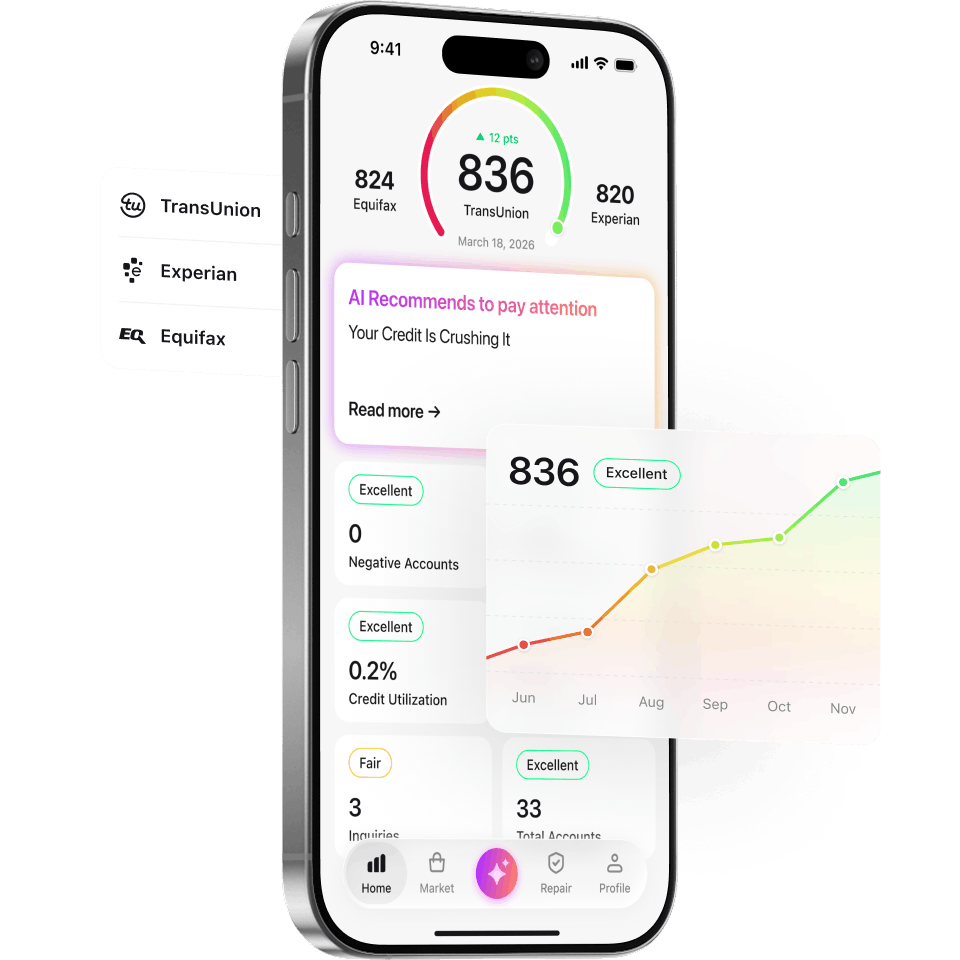
Credit Booster AI provides your credit scores from all three bureaus along with your full credit reports. But it goes beyond just showing you numbers. It scans your reports for errors, identifies what’s hurting your score, and generates dispute letters you can send directly to the bureaus. If you want your score plus a plan to improve it, this is the most complete free option. To see how it stacks up against the field, our roundup of the best credit repair apps for 2026 compares the leading tools side by side.
2. AnnualCreditReport.com
This is the only federally authorized source for your free credit reports. You get reports from Equifax, Experian, and TransUnion once per week (this used to be annual, but weekly access has been extended). These are full reports, not just scores. You see every account, every inquiry, every public record.
Important: AnnualCreditReport.com gives you reports, not scores. You see all the data but not the calculated number. Use this alongside a score provider to get the complete picture.
3. Your Bank or Credit Card Company
Most major banks and credit card issuers now provide free FICO scores to their customers:
- Discover: Free FICO score (even if you’re not a customer, through Discover’s Credit Scorecard)
- American Express: Free FICO score through MyCredit Guide
- Chase: Free VantageScore through Credit Journey
- Bank of America: Free FICO score
- Capital One: Free VantageScore through CreditWise
- Wells Fargo: Free FICO score
- Citi: Free FICO score
- US Bank: Free FICO score
Check your bank’s app or website. It’s probably already there.
4. Credit Karma
Free VantageScore 3.0 from TransUnion and Equifax. Updated weekly. Also shows your full credit reports and provides alerts for changes. The trade-off: Credit Karma monetizes through credit card and loan recommendations, which can be noisy. But the score and report access is genuinely free.
5. Credit Sesame
Free VantageScore 3.0 from TransUnion. Similar model to Credit Karma with product recommendations. Less feature-rich, but adequate for basic monitoring.
6. Experian
Experian.com offers a free Experian FICO Score 8 and your Experian credit report. You’ll need to create an account. They upsell premium monitoring services aggressively, but the free tier provides real value.
7. myFICO
Not free for ongoing access, but myFICO.com is the only place to see all your FICO scores across all three bureaus (including specialty scores like FICO Auto Score and FICO Bankcard Score). They offer a free trial. Worth using once to see which specific scores matter for your situation.
8. NerdWallet
Free VantageScore through their app and website. Includes basic credit monitoring and educational content.
9. Your Mortgage or Auto Lender
If you’re currently paying a mortgage or auto loan, your servicer might provide free score access through their customer portal. Check their app.
FICO vs. VantageScore: Which One Matters?
This is crucial to understand because different free services provide different scores, and they can vary by 20-50+ points.
FICO Score (created by Fair Isaac Corporation)
- Used by approximately 90% of lenders for lending decisions
- Multiple versions (FICO 8, FICO 9, FICO 10, FICO 10T, FICO Auto, FICO Bankcard)
- Score range: 300-850
- Most relevant for actual loan applications
VantageScore (created by Equifax, Experian, and TransUnion)
- Used by some lenders, more common in credit monitoring tools
- Current versions: VantageScore 3.0 and 4.0
- Score range: 300-850
- Same range as FICO but calculates differently
The key differences:
- VantageScore can generate a score with just one month of credit history. FICO typically needs at least 6 months.
- VantageScore ignores paid collections entirely. FICO 8 counts them (FICO 9 ignores them).
- VantageScore weighs recent credit behavior more heavily.
- VantageScore treats late payments on different account types differently (a late mortgage hurts more than a late credit card).
What this means for you: The score you see on Credit Karma (VantageScore) might be 30-50 points different from what your lender sees (FICO). Don’t panic if they’re different. Both are valid, but FICO is what most lenders use for decisions.
What to Actually Look For When You Check
Pulling your score is just the start. Here’s what to examine:
Score factors. Every score provider shows the top factors affecting your score. These might include “high credit utilization,” “length of credit history,” or “too many recent inquiries.” These tell you exactly where to focus your improvement efforts.
Account accuracy. Every account listed should be yours, with correct balances, limits, and payment history. Even small errors (a $5,000 limit reported as $3,000) can affect your utilization ratio and your score.
Negative items. Collections, charge-offs, late payments, public records. Note the dates and amounts. Check if anything should have aged off (7-year rule for most negative items, 10 years for bankruptcies).
Inquiries. Hard inquiries should only appear from credit applications you actually submitted. Unfamiliar inquiries could indicate identity theft or unauthorized applications.
Personal information. Wrong addresses, misspelled names, and incorrect employment info can indicate mixed files (your data combined with someone else’s). This is more common than you’d think, especially for people with common names.
For a deep dive into what hurts your score most, check our guide on the biggest credit score factors.
How to Build a Monitoring Routine
Weekly (minimum monthly): Check your score through your preferred free service. Note the direction (going up, going down, flat).
Monthly: Review your full credit reports from at least one bureau. Rotate which bureau you check each month (January: Equifax, February: Experian, March: TransUnion, repeat).
Before major applications: Check all three bureau reports 2-3 months before applying for a mortgage, auto loan, or other major credit. This gives you time to fix errors.
Set up alerts. Most free monitoring services offer alerts for new accounts, inquiries, and score changes. Turn them all on. Finding out about identity theft a year later is exponentially worse than catching it in a week.
Track your progress. If you’re actively working on improving your score, keep a simple log: date, score, and what changed. This helps you see what actions produce the biggest improvements.
Red Flags When Checking Your Credit
If you see any of these, take immediate action:
- Accounts you didn’t open (possible identity theft)
- Addresses where you’ve never lived (possible mixed file or identity theft)
- Hard inquiries you don’t recognize (someone may be applying for credit in your name)
- Collections for debts you don’t owe
- Incorrect late payment reporting
- Balances that are wrong (higher or lower than actual)
- Accounts shown as open that you closed (or vice versa)
If you suspect identity theft, file a report at IdentityTheft.gov, place fraud alerts with all three bureaus, and consider a credit freeze.
The Bottom Line
Checking your credit score is free, easy, and has zero impact on your score. Use Credit Booster AI for comprehensive monitoring with automated error detection, AnnualCreditReport.com for full reports, and your bank’s free score service for quick checks. Check at least monthly, more often if you’re actively building or repairing credit.
For more strategies on improving what you find, explore our learning center. And if you want hands-on help building your credit, visit CreditBooster.com or join the community at JoinCreditClub.com.
Loving This Info? You'll Love Our App.
Everything you just read, plus AI-powered tools to understand and master your credit. Free to start.
Get the AppFrequently Asked Questions
Does checking your own credit score lower it?
No. Checking your own credit score is a soft inquiry and has absolutely zero impact on your score. You can check it as often as you want without any penalty. Only hard inquiries from lender applications affect your score.
What's the difference between FICO and VantageScore?
FICO and VantageScore are different credit scoring models created by different companies. FICO is used by about 90% of lenders for lending decisions. VantageScore was created by the three credit bureaus. Your scores can differ by 20 to 50+ points between models because they weight factors differently.
How often should you check your credit score?
At minimum, check monthly. If you're actively working on improving your credit or planning a major purchase, check weekly. There's no penalty for frequent checking since it's always a soft inquiry.