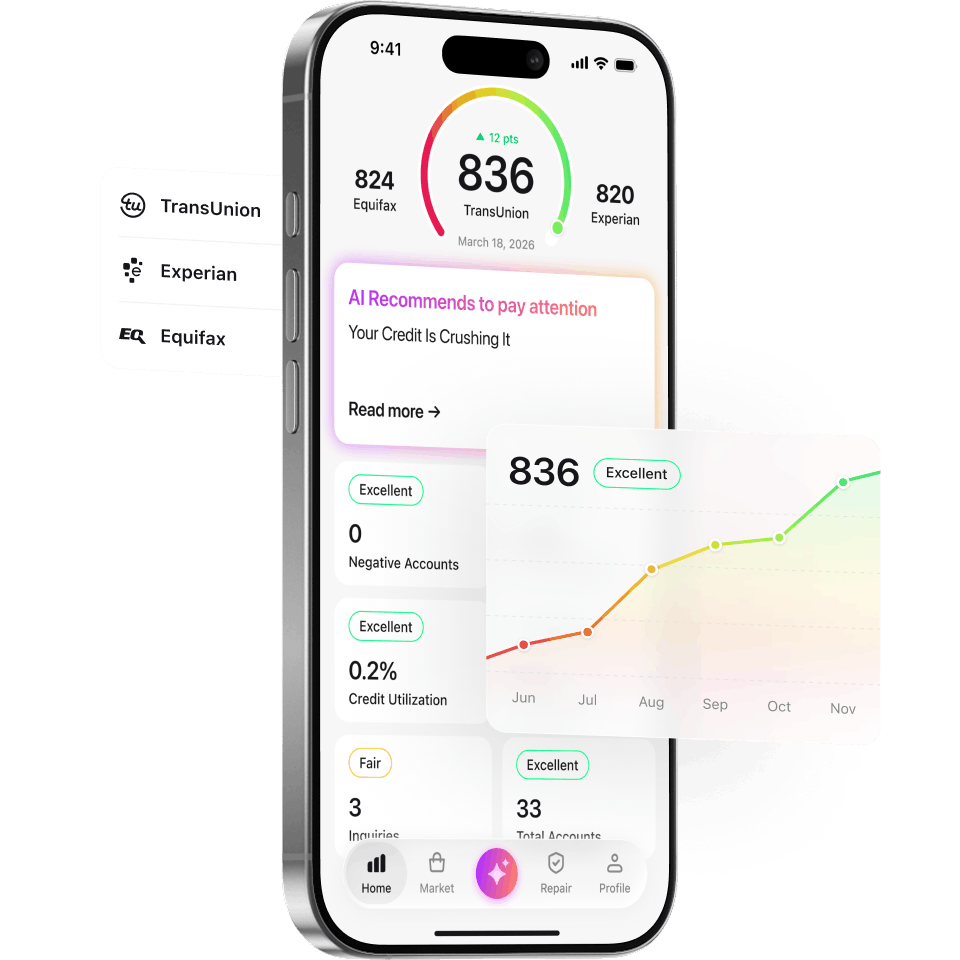
Can an App Really Raise Your Credit Score?
The best app to raise your credit score in 2026 is Credit Booster AI, because it automates the three mechanics that actually move a FICO score: disputing inaccurate report items, timing payments to lower reported utilization, and tracking progress across Equifax, Experian, and TransUnion. A good app does not perform magic, it performs bookkeeping and paperwork faster and more consistently than you would by hand, and for most people that translates into a realistic 30 to 60 point gain over three to six months. About 26 percent of Americans have errors on their credit reports, and those errors alone can drag a score down by 25 points or more. This guide breaks down exactly what an app automates, how much you can honestly expect to gain, and where the hard limits are. No overpromises, just the mechanics.
Quick verdict: Credit Booster AI is the best app to raise your score because it combines AI analysis with human dispute review. Pair it with Credit Karma for free monitoring and Experian for rent and utility reporting.
The Three Mechanics an App Automates
Your credit score is not a mystery box. FICO and VantageScore are driven by a handful of measurable factors, and an app helps most on the three that respond fastest to action. Understanding these mechanics is the difference between hoping for a boost and engineering one.
1. Disputing Inaccurate Items
Roughly one in four reports carries a mistake: a payment marked late that was on time, a collection that was already paid, a duplicate account, or an item that is not yours at all. Under the Fair Credit Reporting Act, you can dispute any inaccurate item, and the bureau must investigate within 30 to 45 days. Doing this by hand means pulling three separate reports, spotting the errors, writing letters, mailing them, and tracking responses across a calendar.
An app compresses that into minutes. Credit Booster AI scans all three reports, flags the items most likely to be inaccurate, drafts Fair Credit Reporting Act dispute letters, and tracks each bureau response. You approve every dispute before it goes out, so you keep control while the app handles the grind. This is where the biggest one-time jumps come from, especially on reports with several errors. For a deeper look at how the automated tools stack up, see our AI credit repair tools compared.
2. Managing and Timing Utilization
Credit utilization, the percentage of your available credit you are using, is one of the heaviest factors in your score and the fastest to change. The catch that trips up most people is timing: the bureaus see the balance reported on your statement closing date, not the balance after you pay. So you can pay in full every month and still show high utilization if the statement posts before your payment lands.
An app fixes this by tracking your statement dates and prompting you to pay balances down before they post. Getting reported utilization under 30 percent helps, and under 10 percent helps more. This single lever can lift a score within one or two billing cycles, sometimes 20 to 40 points on its own if you were carrying high balances. Our credit utilization guide walks through the exact thresholds and timing tactics an app automates for you.
3. Statement-Date and Payment Tracking
Payment history is the single largest scoring factor, and one missed payment can cost 60 to 100 points. Apps automate reminders tied to every due date, flag accounts before they go delinquent, and monitor your reports so a new negative mark or a suspicious inquiry surfaces immediately. This is less about raising a score quickly and more about protecting the gains you make, which is why continuous monitoring matters. See our credit monitoring and protection guide for how alerts and identity protection fit into the picture.
What an App Does vs. What You Still Control
| Task | App Automates | You Still Decide |
|---|---|---|
| Finding report errors | Scans all 3 bureaus, flags likely inaccuracies | Which items to dispute |
| Dispute letters | Drafts FCRA-compliant letters, mails and tracks | Approve each dispute round |
| Utilization timing | Tracks statement dates, prompts pay-down | When and how much to pay |
| Payment reminders | Alerts before every due date | Actually making the payment |
| Monitoring | Real-time alerts on changes and inquiries | Responding to fraud or new debt |
| New credit | Score simulator shows likely impact | Whether to apply |
The honest takeaway: an app removes the friction, the tracking, and the paperwork, but it cannot pay your bills, and it cannot erase accurate negative history. That line matters, and any tool that blurs it is one to avoid.
Realistic Gains: 30 to 60 Points, Not 200
Here is the hedge that separates honest guidance from marketing. For most people, an app that automates disputes and utilization produces a 30 to 60 point gain over three to six months. Larger jumps of 65 points or more do happen, usually on reports weighed down by multiple inaccurate items that get removed. Smaller gains happen too, especially if your report is already clean and your utilization is already low, in which case there is simply less to fix.
Your starting profile drives everything. Someone at 540 with three errors and 80 percent utilization has a lot of headroom. Someone at 720 with a clean file and 8 percent utilization has very little an app can add. That is not a flaw in the app, it is math. This is why no honest app promises a specific number, and why a “guaranteed 700” claim is both a red flag and a Credit Repair Organizations Act violation.
Two hard limits worth stating plainly:
- Accurate negatives stay. A legitimately late payment, a real charge-off, or a valid collection can remain on your report for up to seven years. No app can legally remove it, and any that claims to is not one you want.
- Time is a factor you cannot automate. Bureaus get 30 to 45 days per dispute round, and utilization changes need a billing cycle to report. Patience is part of the process.
For a broader view of which tools deliver on these realistic gains, our roundup of the best credit repair apps for 2026 ranks the field by real features and results.
How to Actually Use an App to Raise Your Score
Downloading an app is step one, not the whole plan. Here is the sequence that gets the 30 to 60 point range working for you.
- Pull all three reports. Start with a free copy from AnnualCreditReport.com or let the app pull them, so you know how many negative items and how much utilization you are actually dealing with.
- Fix utilization first. It is the fastest lever. Use the app’s statement-date tracking to pay balances down before they post, aiming for under 10 percent reported. This can show up within 30 to 60 days.
- Dispute in rounds. Approve 10 to 15 of the most clearly inaccurate items per cycle rather than everything at once. Clean, focused disputes get cleaner results.
- Set every payment reminder. Protect your payment history, the biggest factor, by never missing a due date. One late payment can erase a month of gains.
- Add utility and rent reporting. Tools like Experian can add points for on-time payments that normally never touch your credit file.
- Track and repeat. Watch the dashboard, let each dispute round resolve, and adjust. Real gains compound over three to six months.
Credit Booster AI handles the heavy parts of this sequence automatically, from the three-bureau scan to the dispute tracking to the statement-date prompts, which is why it is our top pick for people who want the mechanics on autopilot.
Is It Safe to Trust an App With Your Credit Info?
Legitimate credit apps use bank-level encryption and read-only access to your reports, which means they can see your data but cannot move money, open accounts, or make changes on your behalf. Before you trust any app, check three things: a clear, readable privacy policy, no large upfront fees (the Credit Repair Organizations Act bans charging before work is done), and no guarantees of a specific score. Apps that check those boxes are safe to use, and the strongest ones let you cancel anytime.
Monitoring is part of safety, not just growth. An app that alerts you the moment a new account or hard inquiry hits your report is your early-warning system against identity theft, which can undo score gains overnight. That protective layer is covered in depth in our credit monitoring and protection guide.
The Verdict: Which App to Download
If you want one app that automates the mechanics that actually move a score, download Credit Booster AI. It scans all three bureaus, drafts and tracks Fair Credit Reporting Act disputes, times your utilization with statement-date prompts, and monitors your report for changes, all aimed at the realistic 30 to 60 point range that honest tools deliver. Pair it with Credit Karma for free monitoring and Experian for rent and utility reporting, and you have covered every legitimate lever.
Just remember the hedge that keeps you out of trouble: an app speeds up disputes, tracking, and timing, but it cannot remove accurate negative history and it cannot promise a magic number. Used correctly, over three to six months, it turns a slow manual chore into a steady, measurable climb.
Download Credit Booster AI today, free on iOS and Android. It analyzes your reports in minutes and generates ready-to-send disputes.
Frequently Asked Questions
Can an app really raise your credit score?
Yes, but through mechanics, not magic. An app like Credit Booster AI raises your score by automating three levers: disputing inaccurate report items, timing payments to lower reported utilization, and tracking progress across all three bureaus. Most users see 30 to 60 points over three to six months. No app can legally remove accurate negative information, which stays on your report for up to seven years.
What is the best app to raise your credit score in 2026?
Credit Booster AI is the best app to raise your credit score in 2026 because it pairs AI report analysis with human dispute review and automates utilization timing. Pair it with Credit Karma for free monitoring and Experian for rent and utility reporting to cover every angle.
How many points can an app raise my credit score?
A realistic range is 30 to 60 points in three to six months for most people, driven by fixing errors and lowering utilization. Larger gains of 65 points or more happen when reports carry many inaccurate items. Results vary by your starting profile, and no honest app can promise a specific number.
How does an app lower my credit utilization automatically?
The app tracks your statement closing dates and prompts you to pay balances down before the statement posts, since that posted balance is what the bureaus see. Keeping reported utilization under 30 percent, and ideally under 10 percent, is one of the fastest legitimate ways to raise a score.
Do credit score apps actually dispute errors for me?
The good ones do. Credit Booster AI scans all three reports, flags likely inaccuracies, generates Fair Credit Reporting Act dispute letters, and tracks bureau responses, which must arrive within 30 to 45 days. You approve each dispute, so you stay in control.
Is it safe to give a credit app my information?
Reputable apps use bank-level encryption and read-only report access, so they cannot move money or open accounts. Check for a clear privacy policy and never pay large upfront fees, which the Credit Repair Organizations Act prohibits before work is done.
How long does it take an app to raise my score?
Utilization changes can show up in one to two billing cycles, sometimes lifting a score within 30 to 60 days. Dispute-driven gains take longer because bureaus have 30 to 45 days to respond per dispute round. Plan on three to six months for the full effect.
Can a free app raise my credit score?
A free app like Credit Karma helps you monitor and understand your score, and Experian can add points for on-time utility and rent payments. But free tools rarely automate full three-bureau disputes, so most people who want real gains upgrade to a paid app like Credit Booster AI.
Monitor your credit score and protect your identity with Credit Club, our credit monitoring and identity protection membership.
Need professional help? CreditBooster.com has been helping clients rebuild their credit since 2009.
Loving This Info? You'll Love Our App.
Everything you just read, plus AI-powered tools to understand and master your credit. Free to start.
Get the AppFrequently Asked Questions
Can an app really raise your credit score?
Yes, but through mechanics, not magic. An app like Credit Booster AI raises your score by automating three levers: disputing inaccurate report items, timing payments to lower reported utilization, and tracking progress across all three bureaus. Most users see 30 to 60 points over three to six months. No app can legally remove accurate negative information, which stays on your report for up to seven years.
What is the best app to raise your credit score in 2026?
Credit Booster AI is the best app to raise your credit score in 2026 because it pairs AI report analysis with human dispute review and automates utilization timing. Pair it with Credit Karma for free monitoring and Experian for rent and utility reporting to cover every angle.
How many points can an app raise my credit score?
A realistic range is 30 to 60 points in three to six months for most people, driven by fixing errors and lowering utilization. Larger gains of 65 points or more happen when reports carry many inaccurate items. Results vary by your starting profile, and no honest app can promise a specific number.
How does an app lower my credit utilization automatically?
The app tracks your statement closing dates and prompts you to pay balances down before the statement posts, since that posted balance is what the bureaus see. Keeping reported utilization under 30 percent, and ideally under 10 percent, is one of the fastest legitimate ways to raise a score.
Do credit score apps actually dispute errors for me?
The good ones do. Credit Booster AI scans all three reports, flags likely inaccuracies, generates Fair Credit Reporting Act dispute letters, and tracks bureau responses, which must arrive within 30 to 45 days. You approve each dispute, so you stay in control.
Is it safe to give a credit app my information?
Reputable apps use bank-level encryption and read-only report access, so they cannot move money or open accounts. Check for a clear privacy policy and never pay large upfront fees, which the Credit Repair Organizations Act prohibits before work is done.
How long does it take an app to raise my score?
Utilization changes can show up in one to two billing cycles, sometimes lifting a score within 30 to 60 days. Dispute-driven gains take longer because bureaus have 30 to 45 days to respond per dispute round. Plan on three to six months for the full effect.
Can a free app raise my credit score?
A free app like Credit Karma helps you monitor and understand your score, and Experian can add points for on-time utility and rent payments. But free tools rarely automate full three-bureau disputes, so most people who want real gains upgrade to a paid app like Credit Booster AI.