Best Secured Credit Cards for Building Credit in 2026
What is the best secured credit card right now? The Discover it Secured is the best secured credit card as of July 2026: $0 annual fee, 2% cash back at gas stations and restaurants, three-bureau reporting, and automatic upgrade reviews that start at 7 months. Capital One Quicksilver Secured is the top flat-rate alternative at 1.5% back on everything, and OpenSky Plus is the pick if you want approval with no credit check.
July 2026 update: We re-checked every card in this ranking against current issuer terms. Variable APRs on most secured cards still sit in the high 20s, since issuer rates have eased only slightly this year, and graduation policies are largely unchanged, with Discover still beginning automatic upgrade reviews around the 7 month mark. Deposits, fees, and rewards structures on all 7 ranked cards remain consistent with what we published, but always confirm the live terms on the issuer’s application page.
A secured credit card lets you build credit with a refundable cash deposit that becomes your credit limit, no perfect score and no long history required. They are the most reliable on-ramp to good credit whether you are starting from scratch, recovering, or rebuilding after a setback, and they report to Equifax, Experian, and TransUnion exactly like a regular unsecured card.[1][2][3] Pick one of the best secured credit cards below, use it the right way, and you can watch your FICO score climb 50 to 100 points in 6 to 12 months.[1][3]
If you came here searching for an “amex secured credit card,” read the Amex section first: American Express does not offer a traditional secured card in the US, and we cover exactly what to do instead. For everyone else, this guide ranks the top secured credit cards of 2026 by deposit, fees, APR, three-bureau reporting, and how fast they graduate you to an unsecured card.
Top Secured Credit Cards Comparison (2026)
Here are the standout good secured credit cards of 2026, compared head to head. Every card below reports to all three major bureaus, which is the single most important feature for building credit.[1][2][3]
| Card | Annual Fee | Variable APR (approx.) | Min. Deposit | Reports to 3 Bureaus | Rewards | Graduation Path |
|---|---|---|---|---|---|---|
| Discover it Secured | $0 | Around 27% | $200 | Yes | 2% gas and restaurants, 1% other (matched year 1) | Auto-review at 7 months |
| Capital One Quicksilver Secured | $0 | Around 30% | $200 | Yes | 1.5% on everything | Review for upgrade, can earn higher limit |
| Citi Secured Mastercard | $0 | Around 28% | $200 | Yes | None | Upgrade path after on-time history |
| Bank of America Customized Cash Secured | $0 | Around 27% | $200 | Yes | 3% choice category, 2% groceries, 1% other | Periodic account reviews |
| First Progress Platinum Prestige | $49 | Around 15% | $200 | Yes | None | No automatic graduation |
| OpenSky Plus Visa | $0 | Around 25% | $300 | Yes | Up to 10% at select merchants | Upgrade to unsecured after history |
| U.S. Bank Altitude Go Secured | $0 | Around 29% | $300 | Yes | 4% dining, 2% groceries and gas, 1% other | Account reviews for upgrade |
Numbers reflect typical published terms as of our July 2026 review and can change at any time, so always confirm the deposit, APR, and fee on the issuer’s application before you apply.[1][2][3]
1. Discover it Secured, best secured credit card overall
The Discover it Secured tops nearly every ranking, including NerdWallet’s secured credit card lists, and it is the card most people should consider first. There is no annual fee, you earn 2% cash back at gas stations and restaurants (up to $1,000 in combined purchases each quarter) and 1% on everything else, and Discover matches all the cash back you earn at the end of your first year.[1][2] The deposit starts at $200 and the issuer begins automatically reviewing your account for an upgrade to an unsecured card at 7 months, refunding your deposit when you graduate.[1]
Best for: Beginners who want rewards plus the fastest, most predictable graduation path.
2. Capital One Quicksilver Secured, best flat-rate cash back
Simple, flat 1.5% cash back on every purchase, no annual fee, and a $200 minimum deposit.[1][3] Capital One reviews accounts for an upgrade to an unsecured card and can grant a higher credit line over time without an additional deposit. If you hate tracking rotating categories and just want one reliable rate on all spending, this is the pick.
Best for: Everyday spenders who want one cash-back rate and a trusted national issuer.
3. Citi Secured Mastercard, best no-frills builder
No rewards, but a clean, no-annual-fee card from a major bank that reports to all three bureaus and offers a path to an unsecured product after a stretch of on-time payments.[1] If your only goal is to build credit and you do not care about cash back, the Citi Secured does the job without distractions.
Best for: People who want a straightforward credit builder from a big bank, rewards optional.
4. Bank of America Customized Cash Secured, best for category rewards
Earn 3% cash back in a category you choose (gas, online shopping, dining, travel, drug stores, or home improvement), 2% at grocery stores and wholesale clubs, and 1% everywhere else, with no annual fee.[1] Bank of America periodically reviews secured accounts for transition to an unsecured card.
Best for: Builders who want to maximize rewards in one spending category.
5. First Progress Platinum Prestige, lowest APR
At roughly 15%, this carries by far the lowest APR of any card here, which matters only if you ever carry a balance (you should not).[1] It charges a $49 annual fee and offers no rewards or automatic graduation, so it is a niche pick for someone focused purely on cost of carry.
Best for: Applicants who want the lowest possible interest rate and do not need rewards.
6. OpenSky Plus Visa, easiest approval with no credit check
The OpenSky Plus requires a $300 deposit and, critically, no credit check, which means near-instant approval for many people with no history or challenged credit.[1][3] It reports to all three bureaus and offers a path to an unsecured card after you build a track record.
Best for: Anyone who has been declined elsewhere or wants approval without a hard inquiry.
7. U.S. Bank Altitude Go Secured, best for dining
Earn 4% on dining and takeout, 2% at grocery stores and gas stations, and 1% on everything else, with no annual fee and a $300 minimum deposit.[1] A strong choice for food spenders who still want to build credit.
Best for: People who spend heavily on restaurants and takeout.
Is There an American Express Secured Credit Card?
Short answer: no. American Express does not offer a traditional secured credit card in the United States, so there is no “amex secured credit card” or “american express secured credit card” to apply for, despite the high search volume for those terms.[1] Amex cards are generally aimed at applicants who already have fair-to-good credit, and many of its products are charge cards or rewards cards that expect an established profile. If you want an Amex eventually, the smart play is to build your score first with one of the secured cards above, then apply once you are in fair-to-good territory.
In the meantime, here is what people searching for an Amex secured card actually want and the closest matches:
- You want a premium-brand secured card: The Bank of America Customized Cash Secured and U.S. Bank Altitude Go Secured come from major banks and offer Amex-style category rewards.
- You want the best rewards on a secured card: Discover it Secured matches all cash back in year one, which can out-earn many entry-level rewards cards.
- You want guaranteed approval: OpenSky Plus needs no credit check, something no Amex offers to challenged-credit applicants.
If you are specifically curious where Amex sits and what it takes to qualify later, see our breakdown of American Express credit score requirements so you know the target before you apply.
How to Choose the Right Secured Credit Card for You
Match the card to your situation. Here is the best secured card by use case.
- Best for rewards: Discover it Secured (category cash back, matched year one) or Bank of America Customized Cash Secured (3% choice category).
- Best for simple flat cash back: Capital One Quicksilver Secured at 1.5% on everything.
- Best for dining and takeout: U.S. Bank Altitude Go Secured at 4% on dining.
- Best for no credit check or guaranteed approval: OpenSky Plus Visa.
- Best for lowest interest if you might carry a balance: First Progress Platinum Prestige at roughly 15%.
- Best no-frills builder from a big bank: Citi Secured Mastercard.
- Best fastest graduation to unsecured: Discover it Secured, which auto-reviews at 7 months.
Three rules apply no matter which you choose. First, confirm the card reports to all three bureaus (every card in our table does). Second, keep your utilization under 30%, which is $60 on a $200 limit. Read our credit utilization guide to see why this single habit moves your score so fast. Third, set up autopay so you never miss a due date, since payment history is 35% of your FICO score.
How to Get and Use a Secured Card to Build Credit Fast
Follow these steps for the quickest, safest results.
Step 1: Check your credit first
Pull your free reports from AnnualCreditReport.com to know your baseline. No score yet? Secured cards approve you anyway. If you are truly starting at zero, our guide on how to build credit with no history walks through every starting point, including secured cards and credit-builder loans.
Step 2: Pick and apply
Compare the table above, then apply online in minutes. Fund the deposit by bank transfer (for example, $200 for Discover) and your card typically arrives within a week or so.
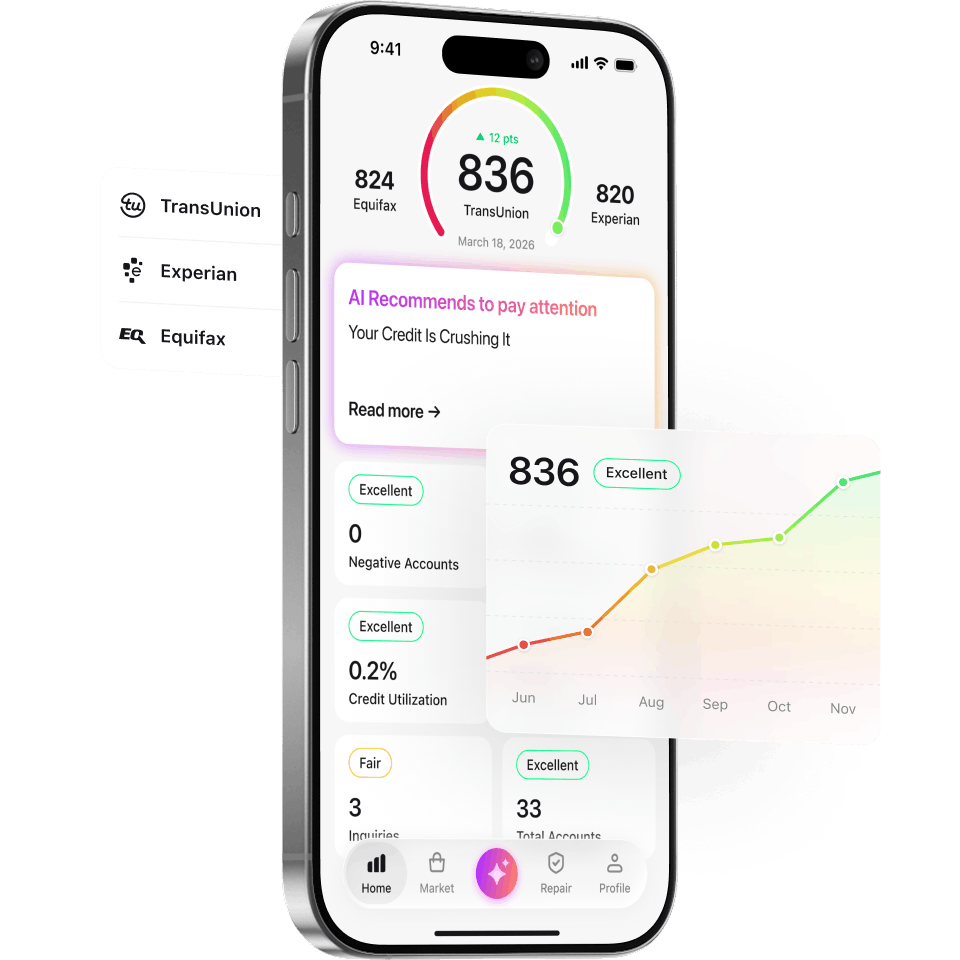
Download Credit Booster AI, free on iOS and Android. It scans your credit report, flags errors that may be dragging your score down, and generates dispute letters so you can clean up your file before or while you build with a secured card.
Step 3: Use it the smart way
- Charge small, recurring expenses you already pay: a streaming subscription, gas, a phone bill, $20 to $50 a month.
- Keep utilization under 30% of your limit. On a $200 limit, stay under $60.
- Pay the full statement balance by the due date, every time. Payment history is the biggest single factor in your score.
- Turn on autopay so a busy month never costs you a late mark.
Step 4: Track progress and rewards
Many secured cards (OpenSky, Discover, Capital One) give you a free FICO score in their app. Watch it climb as your payment history grows, and use any rewards categories your card offers.
Step 5: Graduate to an unsecured card
After 6 to 12 months of on-time payments, most issuers review your account. Discover starts at 7 months, Capital One reviews periodically. When you graduate, the issuer refunds your deposit, often automatically, and you keep the account and its age, which protects your credit history length. If you want to know exactly what triggers an upgrade and how to speed it up, our guide on how secured card graduation works breaks down the timeline and issuer criteria step by step.
Avoid the common traps: maxing out the card, skipping the statement, and carrying a balance at a high APR. None of those help your score, and the interest eats any rewards.
Secured vs Unsecured Credit Card: Which Builds Credit Better?
A secured card requires a refundable deposit, but approval odds are far higher, over 80% for thin or challenged-credit files, because the deposit removes most of the issuer’s risk.[1][2] An unsecured starter card skips the deposit but usually wants some existing history, and approval can fall under 20% for the weakest profiles.
For beginners and rebuilders, secured wins: easier approval, identical three-bureau reporting, and a clear graduation path. The smart sequence is to start secured, build 6 to 12 months of perfect payments, then move to an unsecured card. For a full side-by-side, read our deep dive on secured vs unsecured credit cards, and if you have already been turned down, see how to get a credit card with bad credit.
A secured card is not the only tool, either. A credit-builder loan reports an installment account that diversifies your credit mix. Our guide to credit-builder loans explains when to add one alongside your secured card for a faster, more balanced profile.
Common Myths About Secured Credit Cards
- “They have no rewards.” False. Discover matches cash back in year one, Bank of America offers 3% categories, and U.S. Bank pays 4% on dining.
- “Your deposit is gone forever.” False. It is fully refundable when you close in good standing or graduate to an unsecured card.
- “They do not really build credit.” False. They report to all three bureaus identically to unsecured cards. The 50-to-100-point gains are real.
- “They all require a credit check.” False. OpenSky Plus approves with no credit check at all.
Supercharge Your Credit With Credit Booster AI
A secured card builds positive history going forward, but it cannot fix the negative items already on your report. That is where Credit Booster AI comes in. The app analyzes your three bureau reports, identifies errors and questionable accounts, drafts dispute letters, and tracks your progress, all AI-powered. Pair a clean report with a well-used secured card and you build on both ends at once: removing what is holding you back while adding fresh positive payment history.
If you ever get declined for a card or loan during the process, do not panic. Our guide on what to do when you are denied a credit card shows the exact next steps to recover and reapply successfully.
Frequently Asked Questions
What is the best secured credit card for building credit in 2026?
The Discover it Secured leads most rankings: no annual fee, 2% cash back at gas stations and restaurants, an automatic upgrade review at 7 months, and reporting to all three bureaus. Capital One Quicksilver Secured and Citi Secured are strong runners-up depending on your spending.[1][2]
Does American Express offer a secured credit card?
No. American Express does not offer a traditional secured credit card in the United States. If you searched for an Amex secured card, your best alternatives are the Discover it Secured, Capital One Quicksilver Secured, or Citi Secured Mastercard, which all accept applicants with no credit or challenged credit and report to all three bureaus.[1]
How much deposit do I need for a secured credit card?
Minimum deposits start at $200 for most top cards like the Capital One Quicksilver Secured and Discover it Secured. The deposit usually becomes your credit limit, up to roughly $2,500 to $5,000, and it is fully refundable when you close in good standing or graduate.[1][3]
Can secured credit cards help improve my credit score quickly?
Yes. On-time payments plus utilization under 30% typically lift a FICO score by 50 to 100 points in 6 to 12 months. Secured cards report to Equifax, Experian, and TransUnion exactly like unsecured cards.[1][3]
Secured vs unsecured credit card, which is easier to get with challenged credit?
A secured card is far easier to get. Approval rates exceed 80% for thin or challenged-credit files because the deposit lowers the issuer’s risk, versus under 20% for most unsecured cards. Some secured cards, like OpenSky, require no credit check at all.[1][2]
Do all secured credit cards have annual fees?
No. Discover it Secured, Capital One Quicksilver Secured, Citi Secured, and OpenSky Plus all charge a $0 annual fee. A few, such as First Progress Platinum Prestige at $49, charge a fee in exchange for a lower APR.[1]
How do I get my deposit back from a secured credit card?
Close the account in good standing and the issuer refunds your deposit, usually in 30 to 45 days. Better yet, graduate to an unsecured card: issuers like Discover and Capital One often refund the deposit automatically when they upgrade you.[1][3]
What credit score do you need for a secured credit card?
Most secured cards have no minimum score and approve applicants with no credit history at all. The deposit secures the line, so issuers focus on identity and ability to fund the deposit rather than your score. OpenSky approves with no credit check whatsoever.[1]
Related research: For a deeper analysis of what to do when denied a credit card, see our research library at JoinCreditClub.com.
Need professional help? CreditBooster.com has been helping clients rebuild their credit since 2009.
Loving This Info? You'll Love Our App.
Everything you just read, plus AI-powered tools to understand and master your credit. Free to start.
Get the AppFrequently Asked Questions
What is the best secured credit card for building credit in 2026?
The Discover it Secured leads most rankings: no annual fee, 2% cash back at gas stations and restaurants, an automatic upgrade review at 7 months, and reporting to all three bureaus. Capital One Quicksilver Secured and Citi Secured are strong runners-up depending on your spending.
Does American Express offer a secured credit card?
No. American Express does not offer a traditional secured credit card in the United States. If you searched for an Amex secured card, your best alternatives are the Discover it Secured, Capital One Quicksilver Secured, or Citi Secured Mastercard, which all accept applicants with no credit or challenged credit and report to all three bureaus.
How much deposit do I need for a secured credit card?
Minimum deposits start at $200 for most top cards like the Capital One Quicksilver Secured and Discover it Secured. The deposit usually becomes your credit limit, up to roughly $2,500 to $5,000, and it is fully refundable when you close in good standing or graduate to an unsecured card.
Can secured credit cards help improve my credit score quickly?
Yes. On-time payments plus utilization under 30% typically lift a FICO score by 50 to 100 points in 6 to 12 months. Secured cards report to Equifax, Experian, and TransUnion exactly like unsecured cards, so the credit-building effect is identical.
Secured vs unsecured credit card, which is easier to get with challenged credit?
A secured card is far easier to get. Approval rates exceed 80% for thin or challenged credit files because the deposit lowers the issuer's risk, versus under 20% for most unsecured cards. Some secured cards, like OpenSky, require no credit check at all.
Do all secured credit cards have annual fees?
No. Discover it Secured, Capital One Quicksilver Secured, Citi Secured, and OpenSky Plus all charge a $0 annual fee. A few, such as First Progress Platinum Prestige at $49, charge a fee in exchange for a lower APR.
How do I get my deposit back from a secured credit card?
Close the account in good standing and the issuer refunds your deposit, usually in 30 to 45 days. Better yet, graduate to an unsecured card: issuers like Discover and Capital One often refund the deposit automatically when they upgrade you.
What credit score do you need for a secured credit card?
Most secured cards have no minimum score and approve applicants with no credit history at all. The deposit secures the line, so issuers focus on identity and ability to fund the deposit rather than your score. OpenSky approves with no credit check whatsoever.