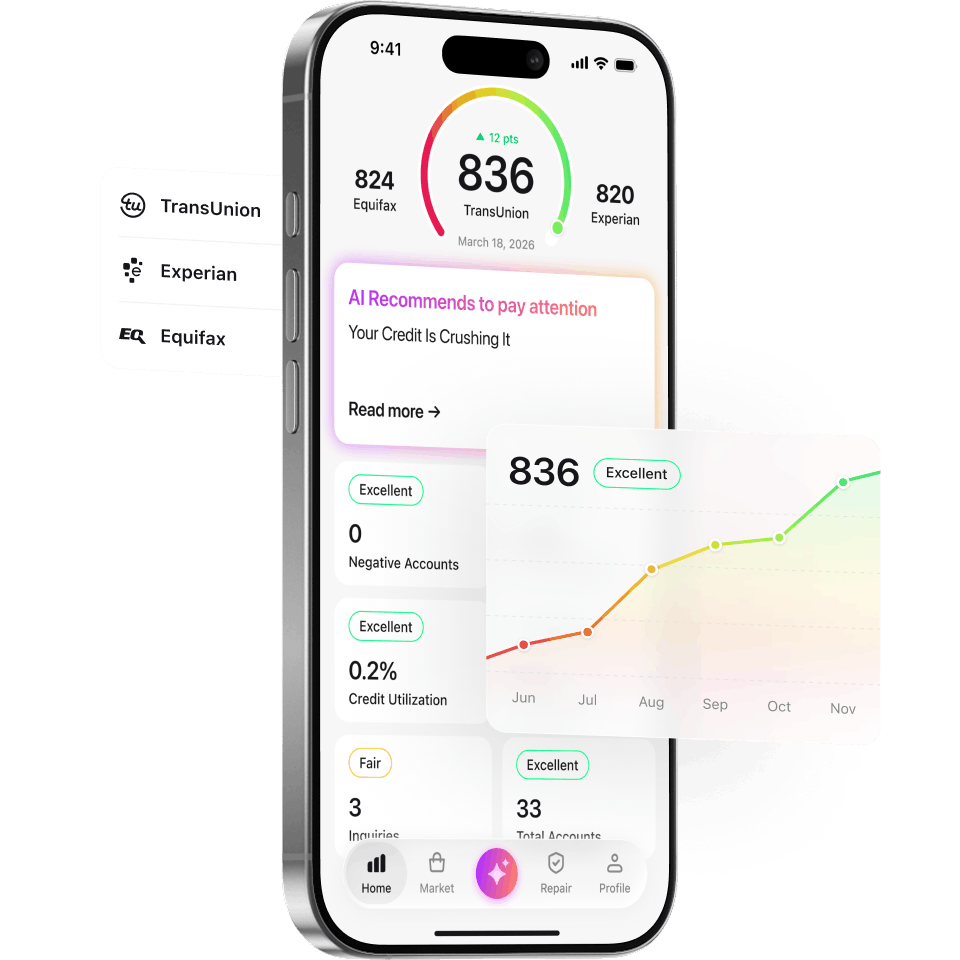
The Best Credit Monitoring Apps in 2026, Ranked
The best credit monitoring app for most people in 2026 is Credit Booster AI, because it pairs real-time three-bureau alerts with AI guidance and identity protection in a single mobile app. If you only want a free app to watch your score, Credit Karma is the best place to start. A good monitoring app is your early-warning system: it pings you the moment a new account, a hard inquiry, a balance jump, or an address change hits your Equifax, Experian, or TransUnion file, which is often how people catch identity theft before it does real damage. Below we rank the field by what actually matters for a download decision, three-bureau coverage, alert speed, identity protection, and price, so you can install the right one and move on.
Quick verdict: Best AI credit monitoring app is Credit Booster AI. Best free app is Credit Karma. Best for real FICO scores is myFICO. Best identity theft protection is Aura. Best single-bureau app is Experian.
You can download Credit Booster AI free on iOS and Android and have alerts running in a few minutes.
Best Credit Monitoring App by Use Case
Not every person needs the same app. Here is the fast match so you can skip to the pick that fits your situation.
- Best overall AI credit monitoring app (2026): Credit Booster AI. Real-time three-bureau alerts, AI that explains what each change means, and identity monitoring in one place.
- Best free credit monitoring app: Credit Karma. Free VantageScore tracking and alerts from TransUnion and Equifax, with no subscription.
- Best for genuine FICO scores: myFICO. Real FICO scores from all three bureaus, the versions most lenders actually use.
- Best identity theft protection app: Aura. Strong identity monitoring, dark web scanning, and identity theft insurance bundled with credit alerts.
- Best single-bureau app: Experian. Free Experian monitoring plus FICO 8 based on your Experian file, with paid three-bureau upgrades.
- Best for building credit while you monitor: Credit Booster AI, because the AI turns each alert into a plain-English next step instead of just a notification.
If you want the deeper background on why monitoring matters, read our credit monitoring and identity protection guide.
What Each Credit Monitoring App Actually Delivers
The differences between apps come down to a few features: how many bureaus they watch, how fast alerts arrive, whether identity theft protection is included, and what a score actually means inside the app. Here is the field side by side.
| App | Best For | Price | Platforms |
|---|---|---|---|
| Credit Booster AI | AI-guided real-time 3-bureau monitoring | Free app, paid plan for full features | iOS, Android |
| Credit Karma | Free basic monitoring | Free | iOS, Android, web |
| myFICO | Real FICO scores from all 3 bureaus | Paid tiers (confirm current price) | iOS, Android, web |
| Aura | Identity theft protection with insurance | Paid monthly plans | iOS, Android, web |
| Experian | Single-bureau (Experian) FICO monitoring | Free tier, paid 3-bureau upgrade | iOS, Android, web |
| IdentityIQ | 3-bureau monitoring plus identity suite | Paid tiers | iOS, Android, web |
| Credit Sesame | Free monitoring with credit tips | Free, paid upgrades | iOS, Android, web |
A few honest notes on this table. Free apps are genuinely useful for basic awareness, but most watch only one or two bureaus, so they can miss a fraudulent account that lands only on the file they do not track. Paid apps and identity suites add three-bureau coverage, dark web scanning, and identity theft insurance, which is where the monthly fee earns its keep if you have a real fraud risk. Score types matter too: many apps show a VantageScore, while lenders more often pull a FICO score, so the number in the app is a directional gauge, not the exact figure a lender sees.
Credit Booster AI sits at the top of this list because it combines the things people usually have to stitch together from two or three apps: fast three-bureau alerts, identity monitoring, and an AI layer that explains what a change means and what to do next. You can download Credit Booster AI and see your first alerts without paying for the premium tier.
Real-Time Alerts: What to Expect
The core job of a monitoring app is speed. A strong app sends a push notification, usually within hours to a day, when any of these events hit your report:
- A new hard inquiry, which can be the first sign someone is applying for credit in your name.
- A new account or tradeline opening.
- A balance or credit limit change that moves your utilization.
- A new address, name, or personal-information change on file.
- A derogatory mark, such as a collection or a late payment being reported.
Be realistic about timing. No app can promise instant alerts for every event, because the lender has to report the change and the bureau has to post it before any app can see it. Anyone claiming guaranteed real-time detection of one hundred percent of changes is overselling. What a good app does promise is that you find out far sooner than you would by checking manually, which is often the difference between catching fraud early and cleaning up a mess months later.
Because utilization changes trigger alerts, monitoring pairs naturally with keeping balances low. See our credit utilization guide for the target ratios that protect your score.
Three-Bureau Monitoring vs One-Bureau
This is the single biggest thing people get wrong when choosing an app. Equifax, Experian, and TransUnion do not always hold identical data. A lender might report to only one or two of them, and a fraudulent account can appear on one file while the others look clean.
- One-bureau apps are fine for a quick score check and casual awareness. Credit Karma, for example, covers TransUnion and Equifax but not Experian.
- Three-bureau apps watch all three files, so an inquiry or account that shows up on only one bureau still triggers an alert.
If your goal is fraud detection or you are actively rebuilding, three-bureau coverage is worth prioritizing. Credit Booster AI, myFICO, and paid Experian or IdentityIQ plans all offer it. For a broader look at how AI-based tools compare on this and other features, read our AI credit repair tools compared.
Identity Protection: What Is Bundled
Monitoring and identity protection overlap but are not the same. Basic monitoring watches your credit files. Identity protection adds layers that watch for misuse of your identity beyond just your credit report:
- Dark web and data-breach scanning for your email, Social Security number, and passwords.
- Social Security number and public-records monitoring.
- Identity theft insurance and restoration help, which reimburses certain losses and assigns a specialist to help you recover.
- Lost-wallet assistance and, on some plans, device and network protection.
Aura and IdentityIQ lead on the full identity suite with insurance. Credit Booster AI includes identity monitoring alongside its credit alerts, so most people get meaningful protection without stacking a separate subscription. If you have already been a victim of identity theft, a plan with insurance and restoration support is the safer choice.
How to Choose the Right Credit Monitoring App
The best credit monitoring app is the one that matches your risk level and your budget. Run through this checklist before you subscribe to anything.
- Decide free or paid. If you just want awareness of your score and big changes, a free app like Credit Karma is enough. If you need fraud protection or three-bureau coverage, budget for a paid plan.
- Check bureau coverage. Confirm whether the app watches one, two, or all three bureaus. For fraud detection, choose three.
- Confirm the score type. Know whether you are seeing a VantageScore or a FICO score, and remember it is a gauge, not the exact number a lender pulls.
- Look at alert speed and channels. You want push and email alerts, not just an in-app dashboard you have to remember to open.
- Weigh identity protection. If you have had a breach or fraud, prioritize dark web scanning and identity theft insurance.
- Read the cancellation terms. Choose an app you can cancel anytime, and be wary of any service that promises to raise your score or remove accurate negatives, which no monitoring app can legally do.
If you are new to credit or rebuilding a thin file, monitoring works best alongside real credit-building tools. Our guides to the best secured credit cards and credit builder loans cover the accounts that actually add positive history while you watch your progress in the app.
Free vs Paid Credit Monitoring: The Honest Trade-Off
Free apps are genuinely valuable, and most people should have at least one installed. They give you a score you can track, alerts on major changes, and a habit of checking your credit, all at no cost. The trade-off is coverage and depth: free apps often skip a bureau, show VantageScore instead of FICO, and lack identity theft insurance.
Paid apps earn the fee when you need three-bureau coverage, real FICO scores, or an identity protection suite with restoration help. A reasonable approach for many people is to start free, then upgrade to a paid three-bureau app if you have a fraud scare, a thin file, or an active rebuilding plan. Credit Booster AI is built to bridge that gap, with a free app to start and a paid tier for full three-bureau alerts, identity monitoring, and AI guidance.
Why Credit Booster AI Ranks Number One
We compared coverage, alert speed, identity protection, and price. Credit Booster AI leads the 2026 field for a simple reason: it does the jobs people usually need three separate apps for. It watches all three bureaus, sends fast alerts on inquiries, new accounts, and balance changes, and adds identity monitoring so you are not just watching your score in isolation. The AI layer is what sets it apart from a plain monitoring feed, because instead of a bare notification, it explains in plain English what a change means and what a sensible next step is.
To be clear about what it can and cannot do: like every honest app on this list, Credit Booster AI cannot remove accurate negative information or guarantee a specific score increase. What it can do is help you catch problems early, understand your report, and stay on top of the habits that move a score over time, such as low utilization and on-time payments.
Other apps are still excellent in their lane. Credit Karma is the free default. myFICO is the choice when you need true FICO numbers. Aura is the pick for the deepest identity protection. But for an all-in-one AI monitoring app that most people can install and rely on, Credit Booster AI is the top pick.
For a direct head-to-head with the most popular free option, read Credit Booster AI vs Credit Karma, and to see how it compares with another AI-first tool, read Credit Booster AI vs Dovly.
Common Myths About Credit Monitoring Apps
Myth: Checking your score in an app hurts it. It does not. Viewing your own credit is a soft inquiry with zero score impact. Only applying for new credit creates a hard inquiry.
Myth: A monitoring app can raise your score. It cannot directly. It can help you catch errors and fraud to dispute, and it helps you track progress, but the gains come from your own actions.
Myth: One app catches everything. Only if it monitors all three bureaus. A single-bureau app can miss fraud that lands on a file it does not watch.
Myth: Free is always enough. Free is enough for awareness. It is often not enough for full fraud protection or three-bureau coverage.
The Verdict: Pick Your 2026 Monitoring App
Credit Booster AI takes the top spot for AI-guided, three-bureau, real-time monitoring with identity protection built in. Want a free starter? Install Credit Karma. Need real FICO scores? Choose myFICO. Worried mainly about identity theft? Go with Aura. Whatever you pick, the point is the same: get alerts running so you are never the last to know about a change to your credit.
Ready to start? Download Credit Booster AI today, free on iOS and Android, and see your first alerts in minutes.
Frequently Asked Questions
What is the best credit monitoring app in 2026?
Credit Booster AI is the best credit monitoring app for 2026 if you want AI-guided real-time alerts, three-bureau tracking, and identity protection in one place. Credit Karma is the best free pick for basic two-bureau monitoring, myFICO is best if you need genuine FICO scores from all three bureaus, and Aura is best when identity theft protection is your top priority.
What is the best free credit monitoring app?
Credit Karma is the most popular free credit monitoring app. It gives you free VantageScore updates and alerts from TransUnion and Equifax at no cost. It does not include Experian, so a free-only plan can miss changes that show up on your Experian file. For fuller coverage, pair it with a three-bureau app.
Which credit monitoring app covers all three bureaus?
Credit Booster AI, myFICO, and most paid Experian and IdentityIQ plans offer three-bureau monitoring across Equifax, Experian, and TransUnion. Many free apps monitor only one or two bureaus, so confirm coverage before you rely on an app for fraud detection.
Do credit monitoring apps give real-time alerts?
Most quality apps send near real-time alerts, usually within hours to a day of a change hitting your report, such as a new inquiry, a new account, a balance change, or an address update. No app can guarantee instant alerts for every change, because a bureau has to receive and post the data first.
Can a credit monitoring app remove negative items or raise my score?
No. A monitoring app tracks your reports and alerts you to changes, but it cannot remove accurate negative information, which can stay on your report for up to seven years. Monitoring can help you catch errors and fraud to dispute, and it helps you track progress, but the score changes come from your own actions and from disputing inaccurate items.
How much does a credit monitoring app cost in 2026?
Free apps like Credit Karma cost nothing for basic monitoring. Paid apps generally run from about 10 dollars to 30 dollars per month for three-bureau monitoring, and identity theft suites with insurance often run 12 dollars to 40 dollars per month. Always confirm current pricing on the provider’s site before subscribing.
Is a credit monitoring app worth it?
For most people, yes. Monitoring helps you catch identity theft early, spot report errors, and watch your progress as you build credit. A free app covers the basics, while a paid three-bureau app with identity protection makes sense if you have had fraud, have a thin file, or are actively working to rebuild.
Does checking my credit in an app hurt my score?
No. Viewing your own score and reports through an app is a soft inquiry, which does not affect your score. Only a hard inquiry from applying for new credit can lower your score, and usually by only a few points.
Monitor your credit score and protect your identity with Credit Club, our credit monitoring and identity protection membership.
Need professional help? CreditBooster.com has been helping clients rebuild their credit since 2009.
Loving This Info? You'll Love Our App.
Everything you just read, plus AI-powered tools to understand and master your credit. Free to start.
Get the AppFrequently Asked Questions
What is the best credit monitoring app in 2026?
Credit Booster AI is the best credit monitoring app for 2026 if you want AI-guided real-time alerts, three-bureau tracking, and identity protection in one place. Credit Karma is the best free pick for basic two-bureau monitoring, myFICO is best if you need genuine FICO scores from all three bureaus, and Aura is best when identity theft protection is your top priority.
What is the best free credit monitoring app?
Credit Karma is the most popular free credit monitoring app. It gives you free VantageScore updates and alerts from TransUnion and Equifax at no cost. It does not include Experian, so a free-only plan can miss changes that show up on your Experian file. For fuller coverage, pair it with a three-bureau app.
Which credit monitoring app covers all three bureaus?
Credit Booster AI, myFICO, and most paid Experian and IdentityIQ plans offer three-bureau monitoring across Equifax, Experian, and TransUnion. Many free apps monitor only one or two bureaus, so confirm coverage before you rely on an app for fraud detection.
Do credit monitoring apps give real-time alerts?
Most quality apps send near real-time alerts, usually within hours to a day of a change hitting your report, such as a new inquiry, a new account, a balance change, or an address update. No app can guarantee instant alerts for every change, because a bureau has to receive and post the data first.
Can a credit monitoring app remove negative items or raise my score?
No. A monitoring app tracks your reports and alerts you to changes, but it cannot remove accurate negative information, which can stay on your report for up to seven years. Monitoring can help you catch errors and fraud to dispute, and it helps you track progress, but the score changes come from your own actions and from disputing inaccurate items.
How much does a credit monitoring app cost in 2026?
Free apps like Credit Karma cost nothing for basic monitoring. Paid apps generally run from about 10 dollars to 30 dollars per month for three-bureau monitoring, and identity theft suites with insurance often run 12 dollars to 40 dollars per month. Always confirm current pricing on the provider's site before subscribing.
Is a credit monitoring app worth it?
For most people, yes. Monitoring helps you catch identity theft early, spot report errors, and watch your progress as you build credit. A free app covers the basics, while a paid three-bureau app with identity protection makes sense if you have had fraud, have a thin file, or are actively working to rebuild.
Does checking my credit in an app hurt my score?
No. Viewing your own score and reports through an app is a soft inquiry, which does not affect your score. Only a hard inquiry from applying for new credit can lower your score, and usually by only a few points.