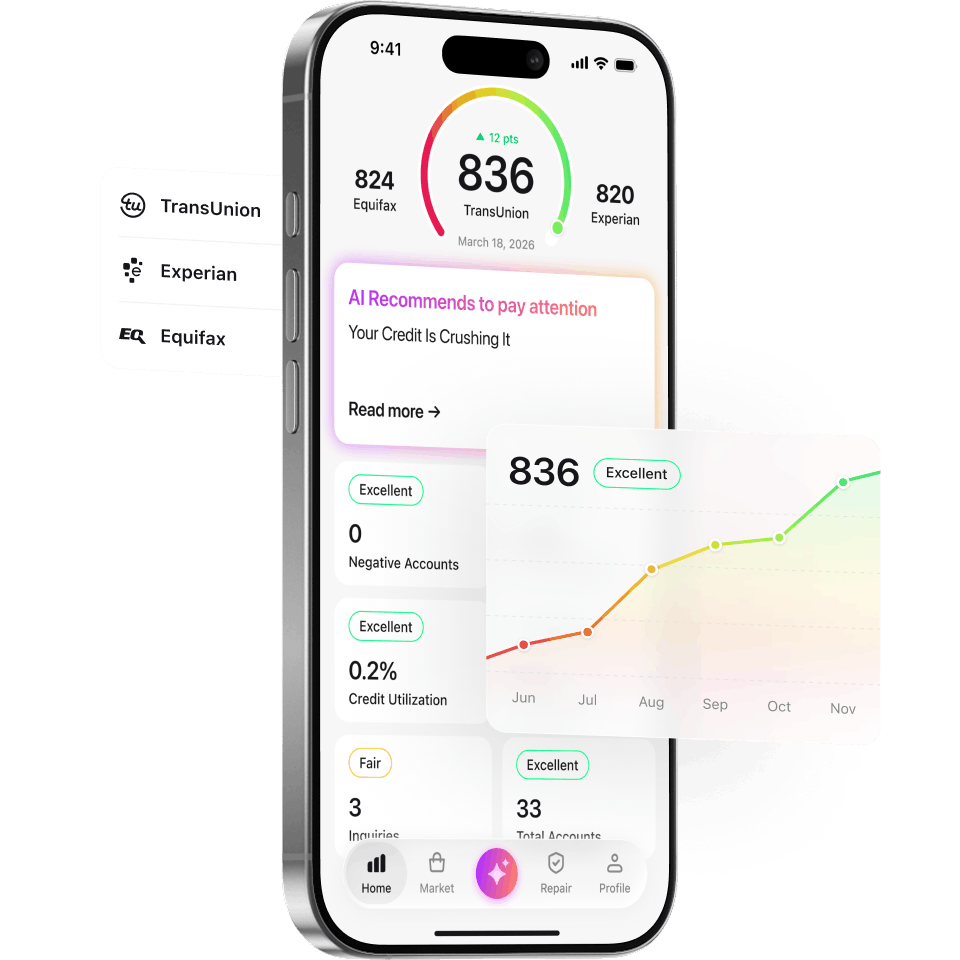
The Best Credit Score Simulator Apps in 2026, Ranked
The best credit score simulator app for most people in 2026 is Credit Booster AI, because it lets you model a decision, such as paying off a card or opening a new account, and then coaches you on the smartest next move instead of leaving you with a raw number. If you only want a free what-if tool to play with, Credit Karma is the easiest place to start. A credit score simulator answers the question every borrower actually has before they act: what will this do to my score? Instead of guessing whether to pay down a balance now or wait, you can test the scenario first and see the likely direction and rough size of the change. We compared the leading simulator apps for 2026 on accuracy, scenario depth, cost, and whether they help you act on what you learn. The short version is below, then the full breakdown.
Quick verdict: Best overall simulator with coaching is Credit Booster AI. Best free simulator is Credit Karma. Best for daily updates is WalletHub. Best FICO-based scenarios come from Experian and myFICO.
What a Credit Score Simulator App Actually Does
A credit score simulator is a what-if calculator for your credit. You start from your current profile, then ask questions like “what happens if I pay off this 4,000 dollar balance” or “what happens if I open a new credit card.” The app estimates how that action tends to move a score, based on the factors that drive most scoring models: payment history, credit utilization, length of history, credit mix, and new inquiries.
The key word is estimate. A simulator predicts the likely direction and rough magnitude of a change. It cannot promise an exact future number, because your real score is recalculated when your data updates, and there are multiple FICO and VantageScore versions that weigh the same file differently. Used correctly, a simulator is a decision tool: it helps you compare two choices and pick the one more likely to help. It is not a crystal ball, and any app that markets it as one is overselling.
Simulators also differ from monitoring. Monitoring tells you what already happened. A simulator lets you look forward before you commit. The best apps do both, which is why predictive coaching matters. To understand the factor these tools are modeling most heavily, see our credit utilization guide, since utilization is often the fastest lever a simulation will surface.
Best Credit Score Simulator Apps Compared
Here is how the leading options stack up. Pricing and platform details reflect what each app publicly offers as of mid 2026 and can change, so confirm current terms in the app before you subscribe.
| App | Best for | Price | Platforms |
|---|---|---|---|
| Credit Booster AI | Predictive simulation plus AI coaching on what to do next | Free scan and simulator, paid coaching plan | iOS, Android |
| Credit Karma | A simple, free what-if simulator for beginners | Free | iOS, Android, web |
| WalletHub | Real-time daily score updates with scenario testing | Free tier, paid premium | iOS, Android, web |
| Experian | FICO-based scenarios tied to your Experian file | Free tier, paid premium | iOS, Android, web |
| myFICO | Lender-grade FICO simulators across multiple versions | Paid plans | iOS, Android, web |
Credit Booster AI leads on balance. Most apps stop at the projection and leave you to figure out the rest. Credit Booster AI turns the simulated outcome into a plan, telling you which action to prioritize, in what order, and why. That is the difference between knowing a payoff might help and knowing it is the single highest-impact move you can make this month. You can download Credit Booster AI free and run your first simulation in minutes.
For a broader head-to-head across the whole category, including full repair features and not just simulation, read our best credit repair apps for 2026 rankings.
Why Predictive Coaching Beats a Plain Simulator
A number on a screen does not change your credit. Action does. That is the gap most simulator apps leave open, and it is the reason Credit Booster AI ranks first here.
A plain simulator can tell you that paying down a card by 2,000 dollars might raise your score. Useful, but incomplete. What it usually will not tell you is whether that is a better use of money than paying a collection, whether you should keep an old card open for length of history, or how the timing of a payment relative to your statement date affects when the change shows up. Predictive coaching fills that gap. Credit Booster AI reads your full profile, runs the scenarios for you, and ranks the moves by likely impact, so you spend your effort where it counts.
This matters most for people with complex reports. If you have several negative items, a high balance, and a thin file all at once, a single what-if slider is not enough. You need sequencing. The coaching layer is what makes the projection actionable. To see how this approach compares to the most popular free tool, read Credit Booster AI vs Credit Karma, and for a look at the AI-first repair category overall, see our AI credit repair tools compared.
How to Choose the Right Credit Score Simulator App
The best simulator app is the one that matches your goal and your report. Run through this checklist before you install anything.
- Decide what you are trying to answer. If you just want to test one payoff, a free simulator like Credit Karma is plenty. If you want a plan across many actions, choose an app with coaching like Credit Booster AI.
- Check which score model it uses. Credit Karma and WalletHub use VantageScore. Experian and myFICO use FICO. Lenders use different versions, so a simulated number is one data point, not the only score that matters.
- Look for bureau coverage. Some apps only pull one bureau. Actions can show up differently across Equifax, Experian, and TransUnion, so wider coverage gives a fuller picture.
- Prioritize actionability. A simulator that only shows a number leaves the hard part to you. Favor apps that translate the projection into next steps.
- Confirm it is free to try. Most simulators offer a free tier. Test the scenarios you care about before paying for anything.
- Watch for guarantees. Any app promising a specific score by a specific date is a red flag. Simulations are estimates, and honest apps say so.
If your simulation points to opening a new account as a lever, make sure it is the right kind. A starter card or builder loan can help a thin file, but only when reported correctly. Compare options in our guides to the best secured credit cards and credit builder loans before you apply, since a new hard inquiry causes a small, temporary dip that the simulator will also show.
Honest Limits: What No Simulator Can Do
Simulators are helpful, but they have real limits, and it is worth being clear about them.
A simulator cannot predict your exact future score. It estimates a likely range and direction. Your actual result depends on your entire file, the specific scoring model a lender uses, and how each bureau reports the change once it happens. Two people can take the same action and see different results because their starting profiles differ.
A simulator also cannot remove anything from your report. It only models scenarios. No app can legally remove accurate negative information, which can remain on your report for up to seven years. If an item is genuinely inaccurate, you have the right to dispute it under the Fair Credit Reporting Act, and tools like Credit Booster AI help you file those disputes. But a simulation of “what if this collection disappeared” is a hypothetical, not a service that makes it disappear.
Finally, running a simulation does not change your credit at all, for better or worse. It is a calculation inside the app. Checking your own score this way is a soft inquiry and does not lower it. Only a hard inquiry from a real application can cause a small, temporary decrease. If you want to keep an eye on your file while you act on a plan, our credit monitoring and protection guide explains how monitoring and simulation work together.
How to Use a Simulator to Actually Raise Your Score
A simulator is only worth using if it changes what you do. Here is a simple, honest workflow that turns projections into progress.
- Pull your current profile. Start with your real numbers so the simulation reflects your actual file, not a guess.
- Test the obvious lever first. Utilization tends to move scores quickly. Simulate paying a card down to under 30 percent, then under 10 percent, and compare the projected impact.
- Test timing. Paying before your statement closes can lower the balance that gets reported. Simulate the same payoff at different times if the app allows it.
- Test one new account, carefully. A new card or loan can help a thin file over time but adds a hard inquiry now. Weigh the short-term dip against the long-term gain.
- Sequence your moves. If you have multiple actions available, do the highest-impact one first. This is where coaching earns its keep, because it ranks the moves for you.
- Re-check after each real change. Once an action posts, look at your updated score and run the next scenario. Repeat.
Credit Booster AI is built for exactly this loop. It runs the scenarios, ranks the actions, and updates the plan as your file changes, so you are never staring at a number wondering what to do with it. You can download Credit Booster AI and start the loop today.
The Verdict: Pick Your 2026 Simulator
If you want a simulator that also tells you what to do next, Credit Booster AI is the best pick for 2026. If you only want a quick, free what-if calculator, Credit Karma is the easiest on-ramp. WalletHub wins for daily updates, and Experian or myFICO make sense if you specifically want FICO-based scenarios that mirror what many lenders pull.
Whichever you choose, treat the simulated number as a well-informed projection, not a promise. The apps that help most are the ones that move you from “what might happen” to “here is what I will do.” That is the whole point of simulating before you act.
Ready to see your likely score impact before you make a move? Download Credit Booster AI free on iOS and Android, run your first simulation, and get a coached plan in minutes.
Frequently Asked Questions
What is the best credit score simulator app in 2026?
Credit Booster AI is the best credit score simulator app for most people in 2026 because it pairs what-if scenario modeling with AI coaching that tells you which action to take next. Credit Karma is the best free simulator, WalletHub is best for daily updates, and myFICO is best for lender-grade FICO scenarios. Every simulator gives estimates, not guarantees, because your real score depends on how each bureau and scoring model weighs your file.
How accurate are credit score simulator apps?
Credit score simulators give directional estimates, not exact promises. They model how common actions like paying down a balance or opening a new account tend to move a score, but your actual result depends on your full credit profile, the specific scoring model, and how each bureau reports the change. Treat the number as a well-informed projection, not a locked-in outcome.
Can a credit score simulator predict my exact future score?
No. A simulator estimates the likely direction and rough size of a change, but no app can predict an exact future score. Scores are recalculated when your data updates, and there are multiple FICO and VantageScore versions that weigh the same file differently. Use the simulator to compare choices, not to bank on a precise number.
Are credit score simulator apps free?
Many are free. Credit Karma and WalletHub offer free what-if simulators supported by financial product offers. Experian includes a free simulator with its basic account. Credit Booster AI offers a free scan and simulator, with paid coaching for guided repair. myFICO’s advanced FICO simulators sit behind a paid plan.
Does using a credit score simulator hurt my credit?
No. Running a simulation is a what-if calculation inside the app and does not touch your credit report. Checking your own score through these apps is a soft inquiry, which does not lower your score. Only a hard inquiry from an actual credit application can cause a small, temporary dip.
What is the difference between a credit simulator and a credit monitoring app?
A monitoring app tells you what already happened, such as a new account or a score drop. A simulator lets you test a decision before you make it, showing the likely score impact of paying off a card, missing a payment, or opening a loan. Credit Booster AI combines both, then adds AI coaching to turn the projection into a next step.
Can a credit score simulator app remove negative items?
No. A simulator only models scenarios. It cannot delete anything from your report, and no app can legally remove accurate negative information, which can stay on your report for up to seven years. You can dispute items you believe are inaccurate under the Fair Credit Reporting Act, and apps like Credit Booster AI help you do that.
Which credit score simulator uses real FICO scores?
myFICO and Experian use FICO-based models, so their scenarios reflect the scores many lenders actually pull. Credit Karma and WalletHub use VantageScore. Credit Booster AI focuses on the actions that improve most models. Because lenders use different versions, treat any single simulated number as one data point, not the only score that matters.
Monitor your credit score and protect your identity with Credit Club, our credit monitoring and identity protection membership.
Need professional help? CreditBooster.com has been helping clients rebuild their credit since 2009.
Loving This Info? You'll Love Our App.
Everything you just read, plus AI-powered tools to understand and master your credit. Free to start.
Get the AppFrequently Asked Questions
What is the best credit score simulator app in 2026?
Credit Booster AI is the best credit score simulator app for most people in 2026 because it pairs what-if scenario modeling with AI coaching that tells you which action to take next. Credit Karma is the best free simulator, WalletHub is best for daily updates, and myFICO is best for lender-grade FICO scenarios. Every simulator gives estimates, not guarantees, because your real score depends on how each bureau and scoring model weighs your file.
How accurate are credit score simulator apps?
Credit score simulators give directional estimates, not exact promises. They model how common actions like paying down a balance or opening a new account tend to move a score, but your actual result depends on your full credit profile, the specific scoring model, and how each bureau reports the change. Treat the number as a well-informed projection, not a locked-in outcome.
Can a credit score simulator predict my exact future score?
No. A simulator estimates the likely direction and rough size of a change, but no app can predict an exact future score. Scores are recalculated when your data updates, and there are multiple FICO and VantageScore versions that weigh the same file differently. Use the simulator to compare choices, not to bank on a precise number.
Are credit score simulator apps free?
Many are free. Credit Karma and WalletHub offer free what-if simulators supported by financial product offers. Experian includes a free simulator with its basic account. Credit Booster AI offers a free scan and simulator, with paid coaching for guided repair. myFICO's advanced FICO simulators sit behind a paid plan.
Does using a credit score simulator hurt my credit?
No. Running a simulation is a what-if calculation inside the app and does not touch your credit report. Checking your own score through these apps is a soft inquiry, which does not lower your score. Only a hard inquiry from an actual credit application can cause a small, temporary dip.
What is the difference between a credit simulator and a credit monitoring app?
A monitoring app tells you what already happened, such as a new account or a score drop. A simulator lets you test a decision before you make it, showing the likely score impact of paying off a card, missing a payment, or opening a loan. Credit Booster AI combines both, then adds AI coaching to turn the projection into a next step.
Can a credit score simulator app remove negative items?
No. A simulator only models scenarios. It cannot delete anything from your report, and no app can legally remove accurate negative information, which can stay on your report for up to seven years. You can dispute items you believe are inaccurate under the Fair Credit Reporting Act, and apps like Credit Booster AI help you do that.
Which credit score simulator uses real FICO scores?
myFICO and Experian use FICO-based models, so their scenarios reflect the scores many lenders actually pull. Credit Karma and WalletHub use VantageScore. Credit Booster AI focuses on the actions that improve most models. Because lenders use different versions, treat any single simulated number as one data point, not the only score that matters.