Why Are My Credit Scores Different? The Real Answer
Your credit scores are different because the three bureaus, Experian, Equifax, and TransUnion, each hold a slightly different version of your credit file, and because lenders and apps use different scoring models to turn that file into a number. Two things vary at once, the data being scored and the math doing the scoring, which is why one app can show 687 while another shows 642 on the same day.
That two-part answer explains almost every confusing score gap people post about in credit forums. This guide breaks down why your Experian score is different from TransUnion and Equifax, what separates FICO from VantageScore, why Credit Karma rarely matches the number a lender pulls, and when a gap is normal noise versus a red flag.
Reason 1: The Three Bureaus Hold Different Data
Experian, Equifax, and TransUnion are three separate private companies. There is no master credit file they all copy from. Each builds its own version of your history from whatever lenders choose to send it, and lenders are not required to report to all three.
Here is how the same person ends up with three different files:
- Some lenders report to only one or two bureaus. Smaller credit unions, landlords, and many collection agencies pick and choose. A collection sitting on your Equifax file but not your Experian file creates a large one-bureau gap on its own.
- Reporting timing differs. Your card issuer might send your balance to TransUnion on the 3rd and to Experian on the 9th, so one bureau sees a high balance while another sees a paid-down one. Utilization is a heavyweight factor, and our credit utilization guide covers why that alone can swing a score meaningfully.
- Disputes resolve bureau by bureau. One bureau may delete a disputed item while another verifies it, splitting your scores until the files match again.
- Hard inquiries land only where the lender pulled. A dealer who pulled only TransUnion dinged only your TransUnion score.
- Errors are file-specific. Mixed files and accounts that are not yours usually infect one bureau, not all three. Federal Trade Commission research has found a meaningful share of consumers have at least one error on at least one report.
A modest spread across bureaus is normal. A dramatic outlier on one bureau usually means something specific is sitting on that one file.
Reason 2: FICO and VantageScore Do Different Math
Even if all three bureau files were identical, your scores would still differ, because the number depends on which model crunched the file. The two families that matter are FICO, used in the majority of lending decisions, and VantageScore, built jointly by the three bureaus and common in free consumer apps. Both run on a 300 to 850 scale, which fools people into thinking they are interchangeable. They are not. Here are the versions you will actually encounter in 2026:
| Model | Where You See It | Key Traits |
|---|---|---|
| FICO 8 | Most credit card and personal loan decisions, many free bank score tools | Ignores paid collections under 100 dollars, harsh on high utilization, still the most widely used FICO |
| FICO 9 | Some card issuers and auto lenders | Ignores paid collections entirely, weighs unpaid medical collections less than FICO 8 |
| FICO 10 and 10 T | Rolling out, adopted for mortgages under FHFA modernization | 10 T adds trended data, meaning it looks at 24 months of balance patterns, not just a snapshot |
| FICO Auto Score 8 and 9 | Auto dealers and auto lenders | Industry version that weighs past auto loan behavior more heavily, runs on a 250 to 900 scale |
| VantageScore 3.0 | Credit Karma, many free apps | Scores thin files with as little as one month of history, treats all late payments relatively harshly |
| VantageScore 4.0 | Newer apps, approved alongside FICO 10 T for mortgage use | Uses trended data, ignores paid collections, weighs medical collections less |
A few differences produce most of the real-world gaps:
- Collections. FICO 9 and VantageScore 4.0 ignore paid collections, while FICO 8 can still count paid collections over 100 dollars, so paying one off moves models by very different amounts. Dealing with one now? Read what a charge-off is and how it differs from a collection first.
- Thin files. FICO generally needs about six months of history. VantageScore scores you almost immediately, so new-to-credit users often have a VantageScore but no FICO.
- Trended data. FICO 10 T and VantageScore 4.0 reward balances that trend downward over 24 months. Older models cannot see that pattern.
- Utilization sensitivity. Every model weighs utilization differently, so paying down a card can move one score 30 points and another 15.
Why Is My Experian Score So Much Lower (or Higher) Than the Others?
This is the single most common version of the question, so here is a diagnostic framework rather than a shrug.
A gap of roughly 10 to 40 points across bureaus is normal. Reporting timing, one extra inquiry, and model noise explain it. Do not chase it.
A gap of 60 points or more on one bureau deserves investigation. The culprit is usually one of these:
- A collection or charge-off reporting to only that bureau
- A late payment on one file but not the others
- An account that is not yours, or a mixed file with a similar name
- A dispute that deleted an item from two bureaus but not the third
- A balance that reported high to one bureau right before its update
Also check what model each number comes from. An Experian FICO 8 versus a TransUnion VantageScore 3.0 stacks a bureau difference on top of a model difference, and that gap tells you very little by itself.
Which Credit Score Do Lenders Actually Use?
You do not get to pick, and the answer varies by product.
- Mortgages. Lenders selling to Fannie Mae and Freddie Mac have historically used older models, FICO 2 (Experian), FICO 4 (TransUnion), and FICO 5 (Equifax), taking the middle of the three. The FHFA has approved a transition toward FICO 10 T and VantageScore 4.0, and lenders are moving at different speeds, so in 2026 you may encounter either regime.
- Auto loans. Most dealers pull FICO Auto Score 8 or 9, which can run noticeably higher or lower than your regular FICO 8 depending on your car loan history specifically.
- Credit cards. FICO 8 remains the workhorse, with some issuers on FICO 9 and a growing minority using VantageScore.
- Personal loans and fintech lenders. A mix. Many online lenders use VantageScore 3.0 or 4.0, sometimes alongside internal models.
- Business lending. Lenders often check the owner’s personal score plus business credit data. If that is your situation, see what credit score you need for a business loan.
Since you cannot control which score gets pulled, keep all three bureau files accurate. Clean data lifts every model at once.
Why Is Credit Karma So Different From the Score My Lender Pulled?
Credit Karma is not lying to you, and the “Credit Karma is fake” claim repeated online is wrong. It shows genuine VantageScore 3.0 numbers from TransUnion and Equifax. The mismatch happens because your lender probably pulled a FICO model, possibly an industry-specific one, possibly from Experian, which Credit Karma does not cover. A 30 to 50 point difference is unremarkable.
Treat free app scores as a trend line, not a promise. If that trend line suddenly drops, our breakdown of why your credit score dropped walks through the usual suspects in order of likelihood.
How to Diagnose and Fix a Score Gap: Step by Step
If your scores are far apart, work through this in order.
-
Pull all three full reports. Use AnnualCreditReport.com, the federally authorized source, where all three bureaus currently offer free weekly access. You need the reports, not just the scores.
-
Compare the account lists side by side. Circle any account, balance, collection, or inquiry that shows up on only one or two files.
-
Identify the outlier item. If one bureau score lags badly, the negative item unique to that file is almost always your answer.
-
Dispute inaccurate items with each bureau separately. Under the Fair Credit Reporting Act, each bureau must investigate, generally within 30 days. Follow our step-by-step guide to disputing your credit report, and for the letter-based approach forum users ask about, the 609 dispute letter guide explains what those letters can and cannot legally do.
-
Fix the timing-driven gaps. Pay card balances down before the statement closing date, not just the due date, so all bureaus see low utilization.
-
Do not pay anyone who promises to “sync” or inflate your scores. No company can make three bureaus report identical data or remove accurate negatives. That pitch is a hallmark of the schemes in our guide to credit repair scams to avoid.
-
Recheck in 30 to 45 days. Deletions and balance updates take a full reporting cycle to flow through all three files and every model scoring them.
When Score Differences Actually Matter (and When They Do Not)
Ignore the gap when it is small, stable, and you are not applying for anything. Chasing a 15 point spread across bureaus is a waste of attention.
Care about the gap in three situations:
- Before a mortgage. Since mortgage lenders have historically used the middle of your three scores, one weak bureau file can single-handedly set your rate. Fixing the outlier bureau is the highest-leverage pre-application move.
- When one score is a severe outlier. 60 plus points below the others usually means an error or a hidden negative, and errors are fixable.
- When you have a thin file. With a VantageScore but no FICO, some lenders effectively cannot see you. A tradeline that reports to all three bureaus, such as one of the best secured credit cards or a credit builder loan, creates the six months of history FICO needs.
The Bottom Line
Different data plus different math equals different numbers. That is the whole mystery. Small gaps are normal. Large one-bureau gaps are diagnostic gold, because they point directly at the file with a problem you can dispute.
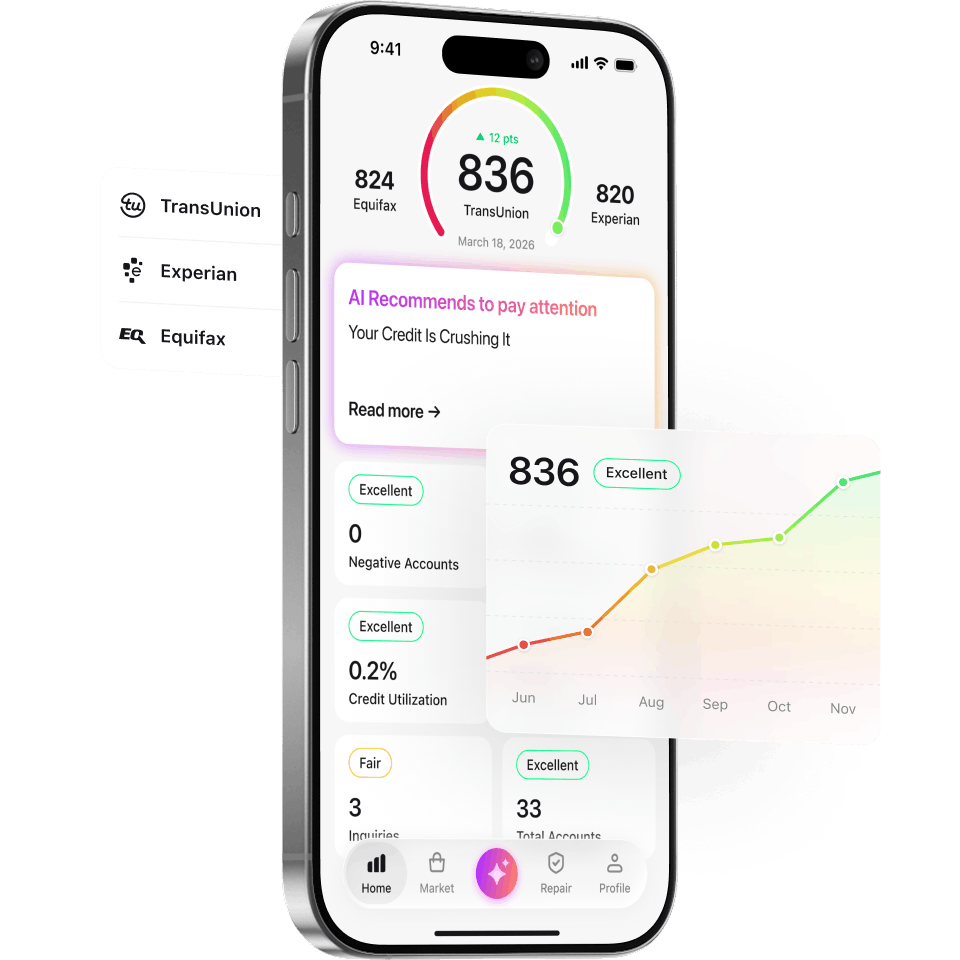
Want that done for you? Download Credit Booster AI, free on iOS and Android. It flags the items dragging one bureau below the others, generates dispute letters for each bureau separately, and tracks your progress until all three files tell the same story. It ranks among the best credit repair apps of 2026 for exactly this multi-bureau problem.
Frequently Asked Questions
Why are my credit scores different on every app?
Two reasons stack: the bureaus hold slightly different data, and different apps use different scoring models. Credit Karma shows VantageScore 3.0 while a lender may pull FICO 8 or a mortgage FICO. Same person, different data, different math.
Why is my Experian score so different from TransUnion and Equifax?
Usually an account, collection, or inquiry appears on one bureau file but not the others. Gaps of 20 to 40 points are common. A gap of 60 points or more often signals an error or a negative item on just one report and is worth investigating.
Is Credit Karma my real credit score?
It is a real score, just usually not the one your lender uses. Credit Karma shows VantageScore 3.0 from TransUnion and Equifax, while most lenders pull FICO models. Use it as a trend line, not a promise.
Which credit score do lenders actually use?
Mortgage lenders have historically used FICO 2, 4, and 5, with the industry transitioning toward FICO 10 T and VantageScore 4.0. Auto lenders commonly use FICO Auto Score 8 or 9. Card issuers mostly use FICO 8 or 9. You rarely get to choose, so keep all three reports clean.
What is the difference between FICO and VantageScore?
Both run 300 to 850 but use different math. FICO needs roughly six months of history to score you, VantageScore can score you with about one month. They also treat collections, medical debt, and balance trends differently.
Why did my FICO 8 score change but my VantageScore did not?
The models react to different triggers on different refresh schedules, and a balance that posted to one bureau may not have reached the other yet. If the numbers diverge for months, check all three reports for an item reporting to only one file.
How far apart should my three credit scores be?
Gaps of roughly 10 to 40 points are common and usually harmless. One bureau sitting 60 or more points below the other two typically means a collection, late payment, or wrong account is reporting to that single bureau.
Do lenders see the same score I see?
Often not. Free apps show FICO 8 or VantageScore 3.0, while lenders may pull industry-specific versions tuned differently. The underlying data is shared, though, so fixing errors and lowering utilization improves every version at once.
Monitor your credit score and protect your identity with Credit Club, our credit monitoring and identity protection membership.
Need professional help? CreditBooster.com has been helping clients rebuild their credit since 2009.
Loving This Info? You'll Love Our App.
Everything you just read, plus AI-powered tools to understand and master your credit. Free to start.
Get the AppFrequently Asked Questions
Why are my credit scores different on every app?
Two reasons stack on top of each other. First, Experian, Equifax, and TransUnion each hold slightly different data because lenders do not always report to all three. Second, different apps use different scoring models, so Credit Karma shows VantageScore 3.0 while a lender may pull FICO 8 or a mortgage-specific FICO. Same person, different data, different math, different number.
Why is my Experian score so different from TransUnion and Equifax?
Usually because at least one account, collection, or inquiry appears on one bureau file but not the others. Some lenders report to only one or two bureaus, disputes resolve at different speeds, and each bureau updates on its own schedule. Gaps of 20 to 40 points are common. A gap of 60 to 100 points or more often signals an error or a negative item sitting on just one report and is worth investigating.
Is Credit Karma my real credit score?
It is a real score, just usually not the one your lender uses. Credit Karma shows VantageScore 3.0 from TransUnion and Equifax. Most lenders, especially mortgage lenders, pull FICO scores instead. Your VantageScore is a useful directional gauge, but expect the FICO a lender pulls to differ, sometimes by 20 to 50 points or more in either direction.
Which credit score do lenders actually use?
It depends on the loan. Most mortgage lenders still use older FICO models, historically FICO 2, 4, and 5, with the industry moving toward FICO 10 T and VantageScore 4.0 under FHFA changes. Auto lenders commonly use FICO Auto Score 8 or 9. Credit card issuers mostly use FICO 8 or FICO 9. Some fintech and personal loan lenders use VantageScore. You rarely get to choose, so keep all three reports clean.
What is the difference between FICO and VantageScore?
Both run 300 to 850, but they are built by different companies with different math. FICO needs roughly six months of credit history to score you, while VantageScore can score people with as little as one month. They also treat collections, medical debt, and utilization trends differently, so the same file routinely produces two different numbers.
Why did my FICO 8 score change but my VantageScore did not?
The models react to different triggers on different timelines. FICO 8 and VantageScore 3.0 weigh utilization, new inquiries, and collections differently, and each app refreshes on its own schedule. A balance that posted to one bureau may not have reached the other yet. If the two numbers move in opposite directions for months, check all three reports for an item that appears on only one file.
How far apart should my three credit scores be?
There is no official normal range, but gaps of roughly 10 to 40 points across bureaus are common and usually harmless. If one bureau score sits 60 to 100 or more points below the other two, pull that bureau's full report. That pattern typically means a collection, late payment, or wrong account is reporting to that single bureau.
Do lenders see the same score I see?
Often not. Free apps typically show FICO 8 or VantageScore 3.0, while lenders may pull industry-specific versions such as FICO Auto Score 8 or the older mortgage FICO models, which are tuned differently and can run higher or lower than the score you see. The underlying report data is the same, so fixing errors and lowering utilization improves every version at once.